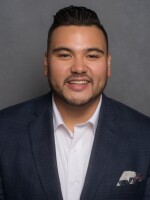
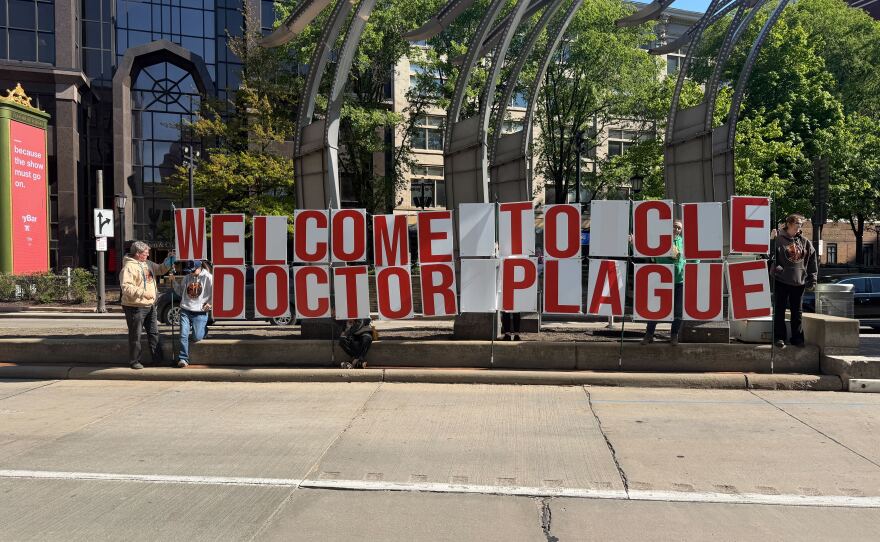
A visit from U.S. Health and Human Services Secretary Robert F. Kennedy, Jr. drew crowds of protesters outside the City Club of Cleveland Thursday night, while the audience inside remained subdued.
Among the protesters was Catherine Park, of Bath, who heads the Rubber City Resistance. She said the group is anti-President Donald Trump, and said those sentiments extend to Kennedy, who Park called a national threat for spreading medical misinformation.
“My sign says ‘RFK is a biohazard.' That’s just entertaining for the people driving by, but it’s also kind of literal. Bio means life and I think he’s a hazard to our lives, because he is an actual threat in terms of keeping us healthy," Park said.
A few medical professionals also stood outside the City Club wearing lab coats as symbols of opposition to what they called Kennedy’s negligent medical opinions, particularly when it comes to vaccines.
“He’s not a physician, and he talks about things and he’s the head of a whole movement, and he doesn’t have the credentials," said James Anderson, a retired neurosurgeon from Cleveland Heights. "And he seems to eliminate people who actually have the credentials from the chain of command in our science community right now.”
Brooke Willis, an HIV/AIDS community educator, also protested outside the forum.
“People don’t believe in science, medicine, people are skeptical about everything because of the things that this administration says," Willis said.


Inside the forum, Kennedy discussed a range of health topics, including drug prices, nutrition and rural healthcare. The audience demonstrated restraint, with some applauding in support of Kennedy's points while others shook their heads in quiet disagreement.
Former Republican congressman Dr. Brad Wenstrup, who moderated the event, said he believes Kennedy has led an effort to prevent chronic illness in the U.S. since his appointment as head of HHS.
Kennedy called chronic disease the "biggest crisis we face as a nation," saying 1.2 million Americans die from chronic illnesses each year. He blamed the country's disease problem on poor diet, and touted his department's recent overhaul of Biden administration dietary guidelines, which he said lacked scientific backing.
Kennedy said he's implemented a half-dozen programs to increase food access and affordability, which he said will improve nutrition, combat chronic illnesses and reduce the risk of health complications. He pointed to the COVID-19 pandemic as an example, claiming deaths from coronavirus were a result of preexisting health issues.
"It was almost impossible for COVID to kill a healthy person," he said.
Kennedy also noted changes to the Supplemental Nutrition Assistance Program (SNAP), including the removal of "certain bad foods" like candy and sugary drinks from the program. He said he also plans to add color-coded labels to packaged foods, with designations based on health risks.

Kennedy pointed to the Rural Health Transformation Program — $50 billion in additional funding to support rural hospitals over the next decade — as a promising way to help stem rural healthcare gaps exacerbated by recent hospital closures. He said HHS has allocated an additional $145 billion to support community health centers.
"(A hospital closure) absolutely decimates that community. ...You lose your community. No business will ever move there because you cant get access to healthcare," Kennedy said, citing the closure of 120 rural hospitals in the past decade. Research by the Cecil G. Sheps Center for Health Services Research found there have been 152 rural hospital closures since 2010.
Healthcare costs will also become clearer under his watch, Kennedy claimed, explaining he intends to push for regulations mandating hospitals and care providers to publish prices in advance. He said HHS is developing a web system that allows users to search pricing for health services.
"Today, if you go to a restaurant, prices are all on the menu. If you go to a car dealer, he's not going to tell you, 'First you buy the car, then I'll tell you what the price is,'" Kennedy said.
U.S. drug prices — both name-brand and generic — were nearly three times higher than 33 comparison countries in 2022, according to research by the Office of the Assistant Secretary for Planning and Evaluation. Kennedy said the weight loss drug Ozempic was $1,350 when he took office, two to three times higher than European countries, because those countries were "better at negotiating prices." He said he had plans to emulate their model.
"We're going to be pharmaceutical center of the world in three years," he said.
Kennedy also addressed the recent announcement that the HHS wants to ween patients off antidepressant medications. He said he aims to develop protocols for prescribing Selective Serotonin Reuptake Inhibitors
(SSRIs) to ensure patients are aware of the risks when coming off such medications.
He then alluded to a recent New York Times article that questioned his claims that SSRIs are partly responsible for the rise in school shootings, and that they could be harder to quit than heroin.
"I happen to be an expert in getting off heroin," Kennedy said, alluding to his 14-year heroin addiction, which he has spoken about publicly. "We need to be more prudent and more humble about prescribing these."