

Although it didn’t make this November’s ballot, many Ohioans are still looking for some form of property tax relief.
At the Maple Heights branch of the Cuyahoga County Public Library, one senior citizen property owner from Garfield Heights said her taxes have doubled. She preferred to remain anonymous, because she’s seeking work and relying on family to pay the bills.
“I had planned to retire, but the way everything is going up is just ridiculous,” she said.
Cuyahoga County’s library system gets 70% of its funding from property tax levies. Many large systems also rely heavily on levies: Both the Cleveland Public Library and the Akron-Summit County system depend on property owners for about half of their budget.
How would libraries cope if Ohio eliminated property tax?
“One of the most disconcerting aspects of that proposition is the lack of any alternate funding source,” said Julianne Bedel, head of the Medina County District Library.
Her system has six branches and an annual circulation of about 3 million items. About 60% of their budget comes from property taxes and goes toward operating expenses.
“When I go home at night living in Medina County, I worry about my police and fire and my school district,” she said. “It kind of blows my mind to think about pulling the rug out of local government, including public libraries. It's not that I don't think that property taxes need to be reformed or looked at. It's that I think it needs to be done in a thoughtful manner with time to make sure that we can manage consequences.”
Ohio’s public libraries are already reeling from cuts to the state’s Public Library Fund instituted in 2025, said Tuscarawas County Public Library Executive Director Michelle McMorrow Ramsell.
“Ohio libraries do not benefit from any county sales tax, city income tax, school district income tax, casino or marijuana income tax,” she said during a recent panel on library funding. “The revenues that public libraries receive are from the state and from local property taxes.”

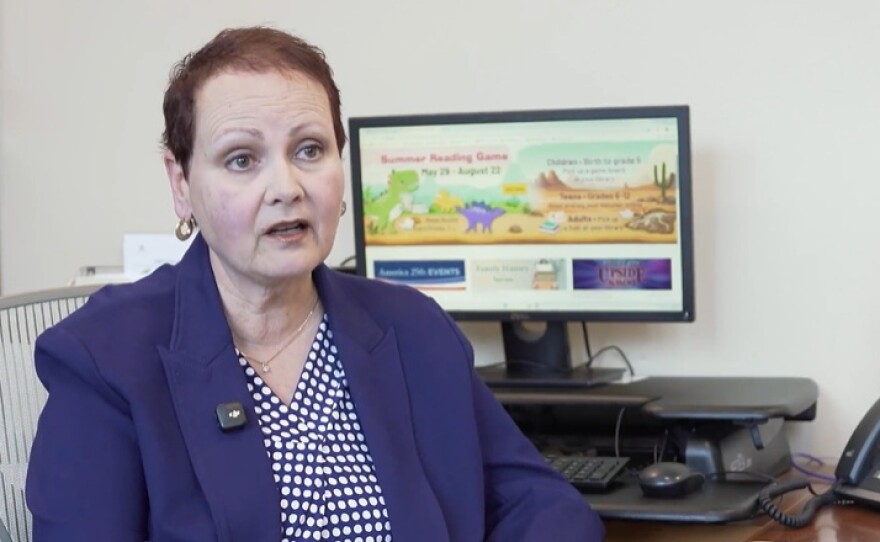


Ramsell said cutting that would be “devastating” for a rural area like Tuscarawas County.
“There are areas of our community that they don't have internet access,” she said. “They'll use a meeting room and borrow one of our laptops so that they can take their online test or so that they can do a job interview.”
Helping a patron sign up for email or complete an online application are just two of the services that Ramsell said would suffer the most. They would also have to pare down the number of materials purchased.
“For families that are trying to make sure that their kids are ready for kindergarten and they're wanting them to read 1,000 books before kindergarten, who has 1,000 books in their home? Not too many people, but they can come to a public library and check those out,” she said.
Yet as Ax Ohio Tax petitions circulate, library advocates wonder if voters realize that they could be cutting their branches too.
“I think that in general, we hear and see a lot of misinformation, a lot of opinion masquerading as fact [and people] maybe not having a good working knowledge of how the taxes are approved and how they're divided,” Bedel said.
The Ohio Library Council said 2.5% of the $24 billion collected from property owners goes to public libraries each year. Although libraries get some funding from grants and donations, 80% rely on some form of property tax levies. Ohio voters seem to recognize that: Over the past two years, 30 of 34 library levies passed.
“I think that this is maybe a little bit of a wake-up call,” Bedel said. “Support isn't won or lost in the year that you're talking about a threat to state funding or to renew your local funding. It really is the work that happens in all those years in between.”


